
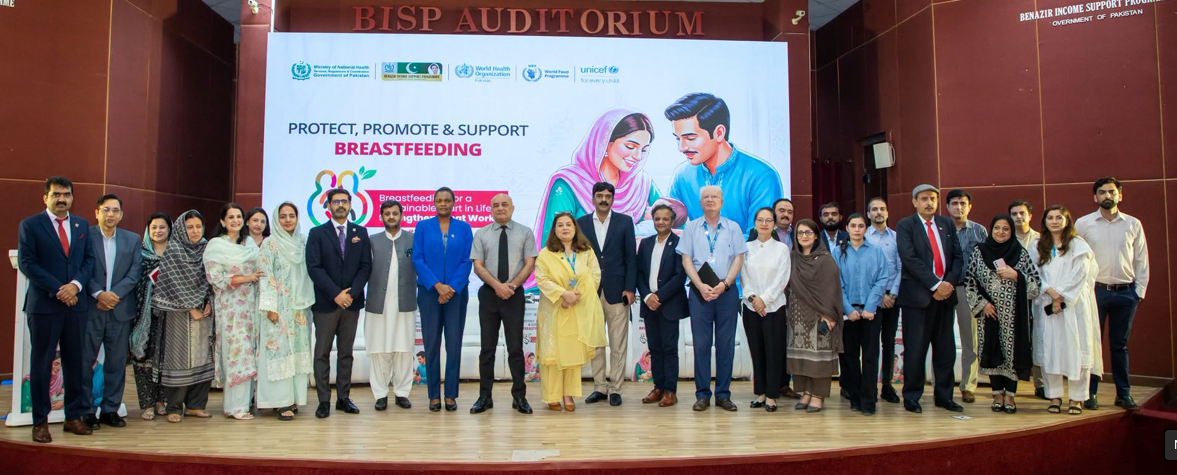
The World Food Programme (WFP), in collaboration with the Benazir Income Support Programme (BISP), UNICEF Pakistan, the World Health Organization (WHO) and the Ministry of National Health Services, Regulations and Coordination, joined efforts to promote breastfeeding and improve maternal and child nutrition during activities marking World Breastfeeding Week 2026 in Islamabad.
The event highlighted the vital role of breastfeeding in improving child nutrition, protecting infants from disease and supporting healthy growth and development. Participants emphasized that mothers need strong family, community, healthcare and social protection systems to enable them to exclusively breastfeed their children.
WFP Pakistan Deputy Country Director Thomas Conan highlighted the importance of adequate nutrition during the first 1,000 days of life, describing this period as a critical window for establishing the foundations of a child’s health and development.
He also highlighted the role of the Benazir Nashonuma Programme, which integrates nutrition and health support with Pakistan’s national social protection system to assist vulnerable pregnant and breastfeeding women and young children.
The programme, launched in 2020, targets pregnant and breastfeeding women and children under two years of age. According to WFP, the programme has reached approximately 4.6 million women and children through hundreds of facilitation and nutrition stabilization centres across the country.
WFP’s Head of Nutrition, Dr Yasir Ihtesham, stressed the importance of establishing supportive environments that enable mothers to exclusively breastfeed and provide their children with adequate nutrition during the critical early stages of life.
The emphasis on the first 1,000 days comes amid continuing concerns over child malnutrition in Pakistan. According to the latest evaluation of the Benazir Nashonuma Programme, children enrolled in the programme were 22 percent less likely to be stunted at six months of age, while the programme also recorded improvements in maternal nutrition, birth outcomes and immunization.
The World Breastfeeding Week activities also underscored the importance of coordinated action between government institutions, social protection programmes and international development partners to create an enabling environment for breastfeeding and maternal nutrition.
The collaboration comes shortly after BISP, WFP, UNICEF and WHO agreed to extend the Benazir Nashonuma Programme for another three years. Under the new phase, an additional 3.3 million women and children are expected to benefit, taking the programme’s projected total reach to around 8 million people.
The partners reiterated their commitment to strengthening nutrition services, supporting mothers and children and ensuring that vulnerable families have access to the resources and information needed to give children a healthy start in life.
The initiative reinforces the message that protecting maternal nutrition, promoting exclusive breastfeeding and investing in the first 1,000 days are essential for reducing malnutrition and building a healthier and more resilient generation in Pakistan.